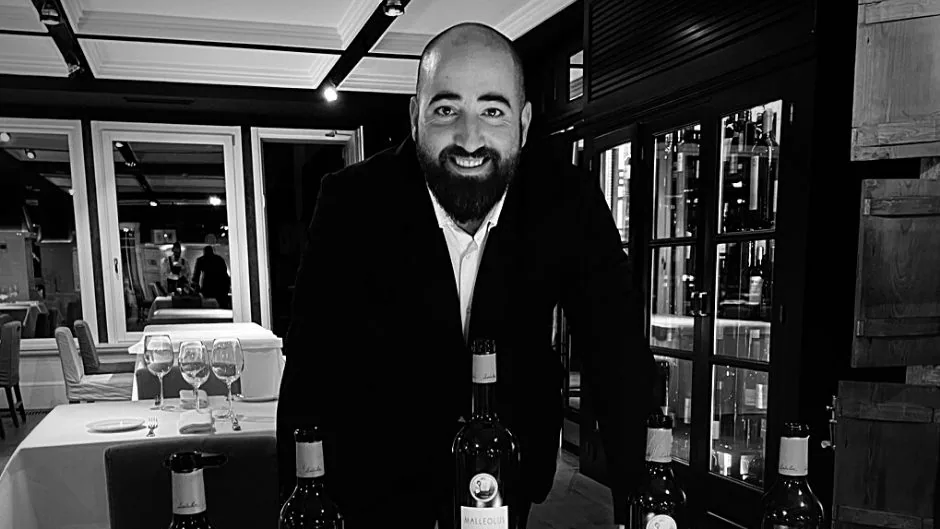
Archive note: the fourteen answers have been restored against the historical capture of Winerim's original Spanish interview and translated in full. Roles, time references and opinions about wines or the product belong to the interview's context, not a current verification. The introduction is editorial. An unrelated pull quote found in the old page is not attributed to this interviewee.
The historical profile presents Manuel Cla as sommelier at El Paladar by Zuriñe García, in Puente Colgante Boutique Hotel. It describes a gastronomic proposal inspired by Basque cooking and recipes passed down through generations, with a creative interpretation. In that context, the conversation explores the relationship between service, the cellar and guests' preferences.
The original introduction described a career of more than ten years in restaurants including Martín Berasategui, Ola Martín Berasategui and Azurmendi, and identified him at the time as the hotel's head sommelier. This information is retained as historical context; it does not confirm his current employment.
1. When did your interest in wine begin?
It really began when I entered hospitality school in Cádiz. That was where Don Antonio Llamas introduced me to wine, and with him I discovered the wonderful world of sherry. I owe him all my curiosity about wine and my love for this profession.
2. What qualities should a good sommelier have?
A good sommelier should, above all, have humility, extensive wine knowledge and general cultural knowledge, be something of a psychologist and understand what guests feel like drinking or what might interest them. You need a good rhythm and just the right gestures for refined, elegant and efficient service.
3. What is the most unusual place where you have organized or attended a wine tasting?
I really enjoy tastings held in the caves of some wineries. The humidity and warm light make it a beautiful experience. My favorite was at a winery in Jerez, surrounded by manzanilla casks.
4. What are the current trends in the sommelier profession?
I think the sommelier role has taken a step forward in quality and is being taken into account in quite a few restaurants. Professionals are constantly training because, in this world, you never stop learning every day, and people are becoming more willing to take advice so they can enjoy different things. Food pairings also let us travel around the Iberian Peninsula without leaving our chairs, simply by drinking our way through it.
5. Tell us about your favourite wines: a white, a red, a rosé and a sparkling wine.
I think choosing just one favourite wine is very difficult, because I am someone who believes a wine becomes perfect according to the moment, the company and the place. Even so, I will share some of those I like most, because I drank them at the right time and in the right place.
For whites, I would choose Manzanilla La Pepa de Romate. For me, it is like drinking a ray of sunshine.
For reds, my favourite is Pintia de Vega Sicilia, an intense, bold wine that is very expressive on the nose.
For rosé, I would choose Viña Tondonia Rosado Gran Reserva. I love its intense, lengthy time in wood.
For sparkling wines, I would find it difficult to decide. Although great sparkling wines are emerging in Spain, I would choose one from Champagne, such as Gosset Gran reserve, subtle and piquant.
6. What should someone with little wine experience look for when choosing a wine to accompany a meal? In other words, what basic rules should a diner know to choose a good wine?
First, they should know their preferences and explain them to the professional looking after them. From there, choose the wine that best suits the menu they have selected.
7. Debunk a myth about wine and food pairing.
That red wine is for meat and white wine for fish. There is an endless variety of wines that pair very well with foods, although we often think those combinations would be absurd. I strongly advocate pairings with sherry wines, because they bring unique nuances that, when paired well with a great dish, can enhance both.
8. What does a wine need in order to be a good wine?
That is very personal, because I think every wine has its time and place. I look for surprising wines from different areas so that people who visit us can try different things.
9. What steps should an amateur follow when tasting wine?
First of all, look at the colour, smell it, try to identify aromas and see whether they remind you of something. Moments are important to me, and some wines take me back to the first time I tasted them, or to a particular moment in my life, just by smelling them.
10. Which wine has surprised you most recently?
The Oloroso "encontrado" from Bodegas Sánchez Romate, a wine whose oxidative aging I absolutely love.
11. What is the best value-for-money wine you have tried?
Finca las Caraballas Verdejo, a very interesting wine that is versatile with different types of food. Its winemaking and balance are incredible.
"Winerim lets me keep very good control of stock."
12. A traditional paper wine list or a digital wine list?
I have always been a pen-and-paper person, but I love having a digital list that lets you make lots of changes.
13. How does Winerim help you in your work?
It helps by giving me the freedom to keep a flexible wine list from day to day, without constantly printing and throwing away paper. It also lets me keep very good control of stock.
14. Finally, one piece of advice for any wine lover.
Try things! We need to taste, step outside our comfort zone and, of course, share!