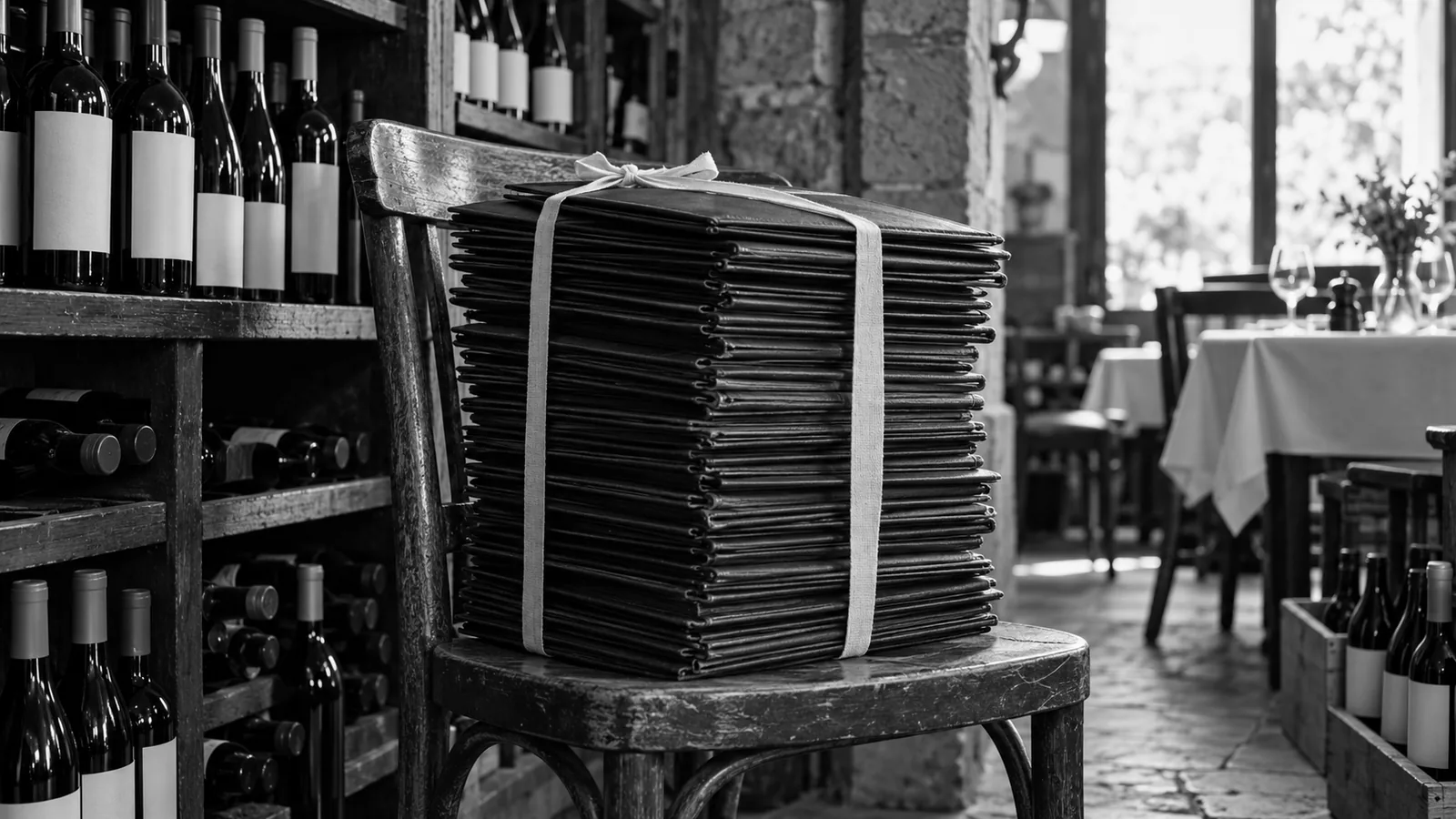
The myth of the extensive wine list
There is a deeply rooted belief in hospitality: the more wines, the better the list. But an excessively long list does not impress: it can make choosing harder and increase capital requirements and management work.
Definition: a wine list is too long when it contains wines that serve no clear purpose, do not turn over regularly or compete for the same customer.
Signs that your wine list is too long
1. The team does not know the whole list
Review which wines the team can explain and what training it receives. Three months and 80% can serve as questions in your own exercise, not as a validated scale of operational capability.
2. More than 20% of wines do not sell in a month
Fictional example: if 20 out of 80 wines record no sales in 30 days, they represent 25% of the wines. Investigate whether they are seasonal, intended for cellaring or serve another purpose before considering them unnecessary.
3. Customers constantly ask for help
If customers cannot find what they are looking for, review the organisation and descriptions. Asking for advice can also be a customer's choice, not proof of poor design.
4. You have several wines in the same niche
Three Rioja Crianza wines between €25 and €30 are an example of possible overlap, not proof of redundancy. Compare style, demand, margin and role before removing any of them.
5. Total stock exceeds 120 days of sales
More than 4 months of cover can serve as an indicative review signal. It is not a universal maximum: check the cellaring role, seasonality, purchasing lead times and whether the sales rate used is representative.
The real cost of an excessively long wine list
| Item | Impact |
|---|---|
| Tied-up capital | Required stock depends on purchasing format and demand; there is no universal minimum of 6-12 bottles |
| Management complexity | More wines may require more records and updates; they do not necessarily mean more suppliers |
| Team confusion | Check whether training and recommendations cover the list, without assuming that only 5 wines sell |
| Difficulty choosing | Observe whether organisation and options help customers choose; do not automatically attribute choosing a low price to list size |
| Lost opportunity | Wines that do not turn over occupy the budget for wines that could sell |
How many wines do you actually need?
| Venue type | Illustrative range | Another size scenario for comparison, not a validated maximum |
|---|---|---|
| Wine bar | 25-40 | 60 |
| Casual dining | 30-50 | 70 |
| Gastronomic restaurant | 50-80 | 120 |
| Fine dining with a cellar | 80-150 | 250 |
| Multi-restaurant hotel | 60-100 per outlet | 150 |
The figures in the table are illustrative scenarios, not industry recommendations or demonstrated efficiency maxima. The key is not the absolute number but ensuring that every wine has a clear role: a price niche, a distinctive style, a specific pairing.
How to shorten the list without losing value
Step 1: Classify each wine
For each wine, answer: what role does it serve? Does it sell regularly? Does the team know it? Does it generate margin?
Step 2: Identify redundancies
Do you have 2+ wines serving the same purpose, with the same style, price and region? Assess their performance and role; do not automatically remove wines just because they share a style, region or price.
Step 3: Remove dead-stock wines
Review wines with no sales for more than 90 days, without automatically removing them: cellaring, seasonality and their role on the list may justify keeping them.
Step 4: Reallocate the budget
Removing a wine from the list does not itself release cash. Review what stock is actually sold or returned before reallocating budget to wines that work.
Step 5: Communicate with the team
A reduction may make work easier if accompanied by appropriate wine notes and training. Check which wines the team can explain before and after.
Frequently asked questions
Doesn't shortening the list make it look less prestigious?
Quite the opposite. A curated, coherent list conveys more judgement than an inflated one. A list's usefulness depends on its selection criteria and suitability for its audience, not on assuming that all the best restaurants share one size.
What should I do with stock of wines I remove?
Options: offer them by the glass at a special price, include them in tasting menus, negotiate a return with the supplier or sell at cost to clear them quickly.
How do I maintain variety with fewer wines?
Make sure each wine covers a different niche. 50 well-distributed wines offer more real variety than 100 where half overlap.
How often should I review the list's size?
Quarterly. Each review includes turnover analysis, removal of dead stock, assessment of gaps and decisions on new additions.