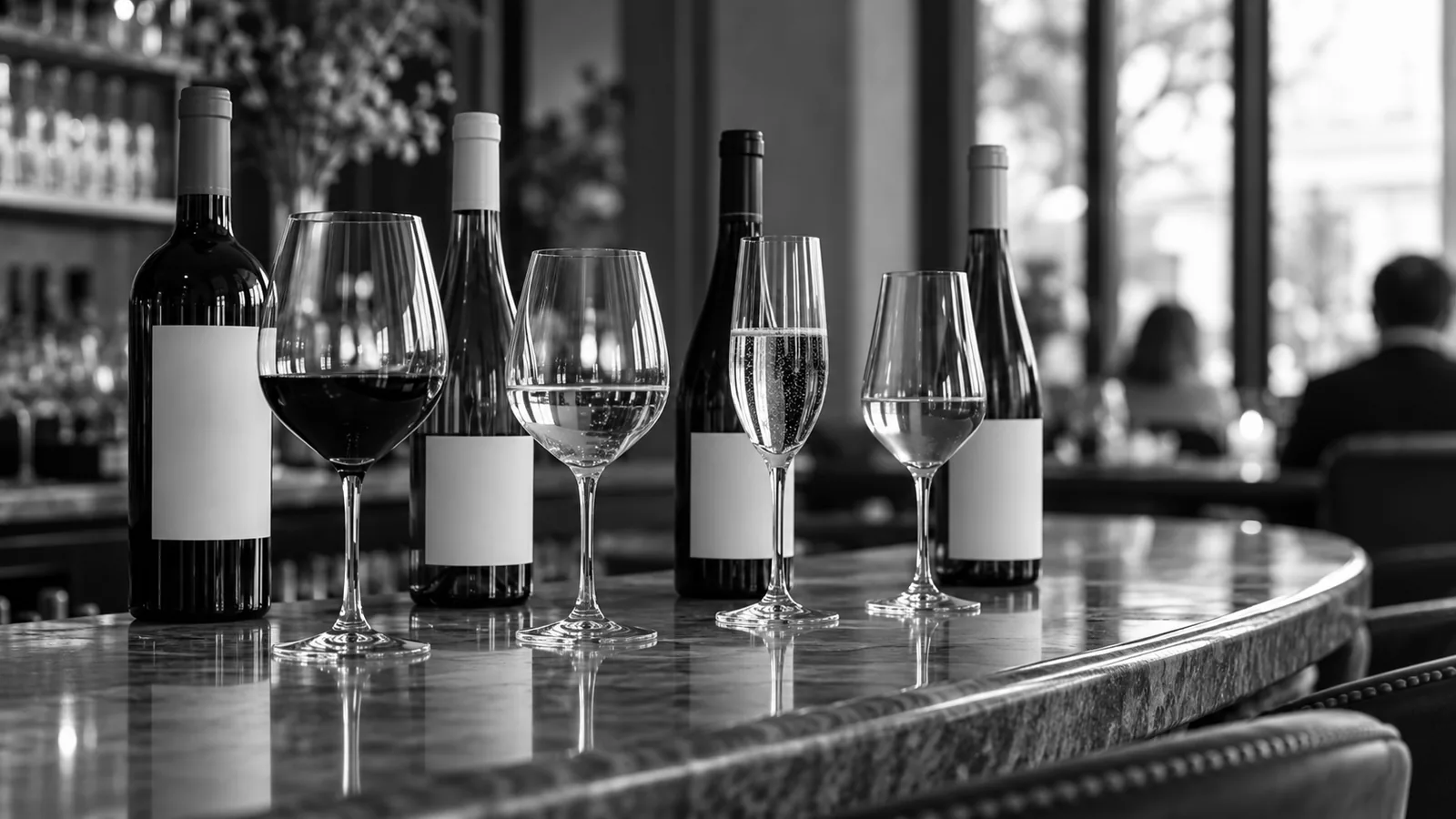
There is no universal by-the-glass selection
The question "which wines should I offer by the glass?" has no single answer. It depends on three variables: your cuisine, your audience and your positioning. A gastro tavern and a 5-star hotel need radically different selections.
The questions below offer a review method, not a universal selection or market benchmarks. Quantities and prices in euros are illustrative scenarios, not Winerim prices or recommendations valid for every venue.
Selection by restaurant type
Casual restaurant / gastro tavern
Objective: accessibility, fast turnover, high margin
| Type | Wines by the glass | Profile | Illustrative selling price |
|---|---|---|---|
| Sparkling | 1 | Accessible cava/prosecco | €4-6 |
| White | 2 | 1 fresh + 1 aromatic | €4-7 |
| Rosé | 1 | Light, versatile | €4-6 |
| Red | 2 | 1 young + 1 structured | €4-7 |
| Total | 6 |
Key: a narrow price range, wines that are easy to understand, high turnover.
Gastronomic restaurant
Objective: experience, pairing with the cuisine, exploration
| Type | Wines by the glass | Profile | Illustrative selling price |
|---|---|---|---|
| Sparkling | 1-2 | 1 cava/prosecco + 1 champagne | €6-12 |
| White | 2-3 | A variety of styles and regions | €6-10 |
| Rosé | 1 | Food-friendly, structured | €6-9 |
| Red | 2-3 | A diversity of body and origin | €7-12 |
| Fortified | 0-1 | Fino/manzanilla as an aperitif | €5-8 |
| Total | 6-10 |
Key: coherence with the cuisine, a variety of experiences, the option of by-the-glass pairings.
Hotel / resort
Objective: cover multiple drinking occasions, standardisation
| Type | Wines by the glass | Profile | Illustrative selling price |
|---|---|---|---|
| Sparkling | 2 | 1 accessible + 1 premium | €6-15 |
| White | 3 | A broad, international variety | €6-12 |
| Rosé | 1-2 | Assess according to pool/terrace demand | €6-10 |
| Red | 2-3 | From local to international | €7-14 |
| Sweet | 0-1 | For dessert or an aperitif | €6-10 |
| Total | 8-11 |
Key: broad coverage, brand recognition, a preservation plan appropriate to the wine, demand and service conditions.
Restaurant with a specific cuisine (Japanese, Peruvian, Indian...)
Objective: specialised pairing, surprise, education
Review the selection's affinity with the cuisine, audience and positioning, without a universal alignment metric. As a planning example, a Japanese restaurant could consider 2-3 sake options by the glass alongside 4-5 wines selected for their affinity with the dishes.
The 3 criteria for choosing each by-the-glass wine
1. Does it pair with at least 3 dishes on your menu?
Check its fit with several dishes. Three is a planning question, not a validated minimum; a wine for a single dish can make sense if demand and preservation justify it.
2. Does it have a viable margin?
Calculate cost per usable serving from bottle cost, actual yield and wastage; then review price and margin using consistent criteria. Recovering the bottle cost in two or three glasses is one possible commercial rule, not a universal profit formula or a guarantee.
3. Is it easy to restock?
A rotating by-the-glass wine can have limited availability. A permanent by-the-glass wine should be one your supplier can provide consistently.
Mistakes by venue type
- Casual: offering overly expensive glasses. Comparing a €9 glass with a €14 set menu raises a positioning question, but does not by itself demonstrate a mismatch
- Gastronomic: not offering sparkling wine by the glass. It can be an aperitif and food-pairing option depending on cuisine and demand
- Hotel: not considering consumption outside the restaurant, such as the bar, pool or room service. The by-the-glass selection should work across all service points
- Themed: not aligning the selection with the cuisine. A Mexican restaurant should explore wines that pair with spices and heat, not offer the same selection as an Italian one
Frequently asked questions
Should I offer local wines by the glass?
Yes, especially if your audience includes tourists. Local wine by the glass acts as an ambassador for the region.
Is offering rosé by the glass compulsory?
It is not compulsory. Review your customers' demand, the season and the cuisine: no growth rate has been validated for this article.
Can I offer a premium wine by the glass without a preservation system?
It depends on the wine, turnover and storage conditions. Do not use a universal 24-48-hour period as a guarantee of quality or profitability. Record opening, storage, wine assessment and wastage, and decide whether the system is appropriate before offering it.
How many rotating by-the-glass wines should I have?
Set the number according to demand, recommendation capacity and preservation. As planning examples, not benchmarks: a selection of six could try two rotating wines, and a selection of ten, three or four; check the results before setting a rule.