
Artificial intelligence for restaurants
How AI is helping restaurants sell more wine, optimize their cellar and improve the guest experience.
The silent revolution
AI is already transforming hospitality
Artificial intelligence isn't science fiction: it's already present in thousands of restaurants worldwide. From smart booking systems to predictive demand analysis, AI enables better decisions with less effort.
But there's one area where the impact can be especially large: wine sales. Wine is the highest-margin product in hospitality, but also one of the hardest to sell without a clear strategy. AI changes the game.
The problem
Why restaurants lose wine sales
Without smart tools, wine sales depend on chance, not strategy.
Untrained staff
Most waiters can't recommend with confidence, holding back sales of higher-value references.
Confusing lists for guests
Endless listings without context make guests choose by price, not preference.
Decisions without data
Wine buying and list design are based on intuition, not real performance analysis.
Impulse selling, not strategy
Without recommendation tools, wine is sold (or not) randomly, losing margin and opportunities.
Practical applications
How AI helps sell more wine
AI transforms every wine touchpoint into a sales opportunity.
Smart recommendations
AI analyzes guest preferences, chosen dish and context to suggest the perfect wine every time.
Automatic pairings
Algorithms cross-reference organoleptic profiles with the food menu to propose optimal combinations.
Sales analysis
Real-time dashboards showing which wines sell, which rotate poorly and where hidden margin lies.
List optimization
Automatic detection of gaps, style duplications and poorly structured price ranges.
Rotation prediction
Predictive models that anticipate which references need a push and which risk expiring.
Winerim
AI designed for wine sales
Winerim applies AI specifically trained for the wine hospitality world. It's not a generic chatbot: it's a platform that understands oenology, pairings, list structures and guest behavior.
Analyzes your wine list
Detects price imbalances, style duplications and improvement opportunities in minutes.
Recommends wines to guests
A virtual sommelier that guides guests to the best choice based on their tastes and dish.
Optimizes structure
Reorganizes categories, price ranges and references to maximize conversion.
Improves rotation
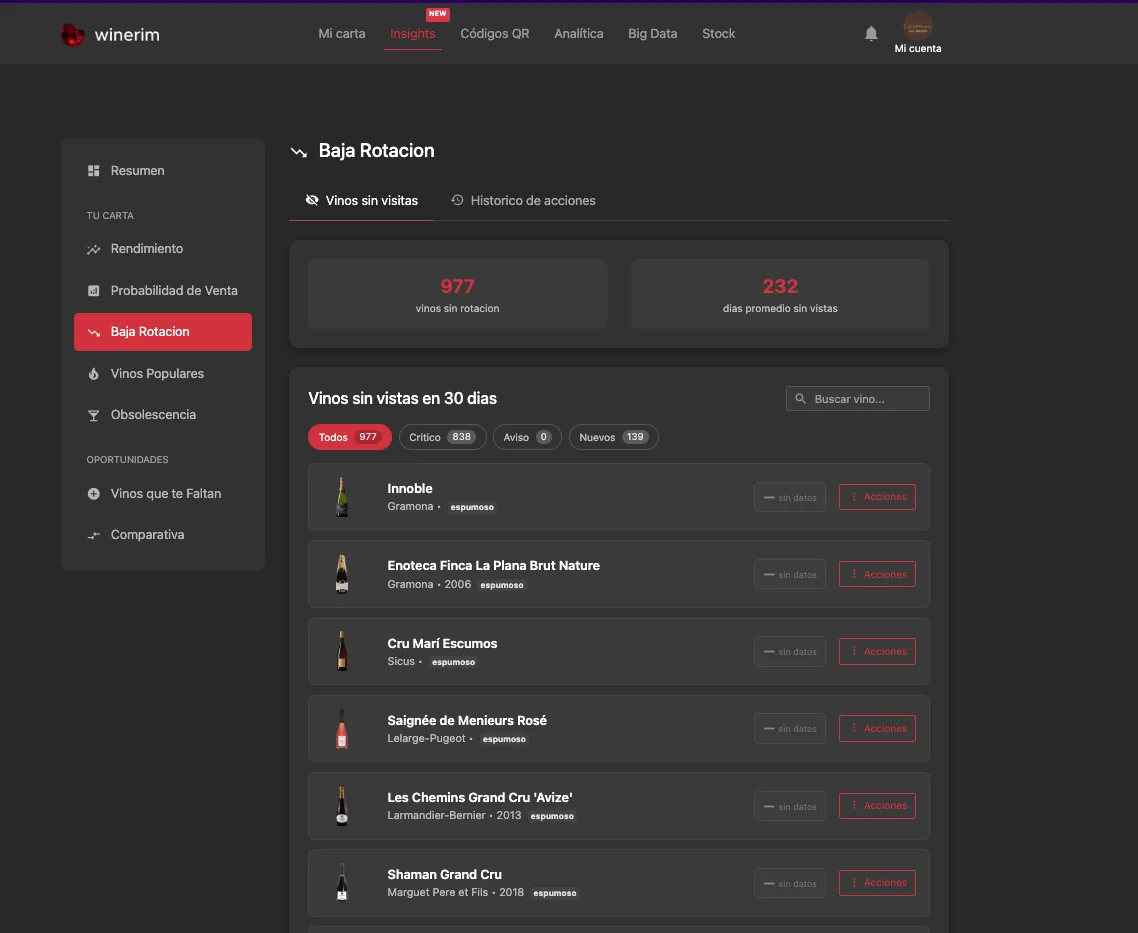
Identifies stagnant wines and proposes strategies to move stock intelligently.
Benefits
What do restaurants achieve with AI?
Looking ahead
The future of AI in restaurants
More restaurants will adopt AI-powered tools to make informed decisions. From supplier selection to personalizing the dining experience, AI will become an essential ally.
Restaurants that integrate AI into their daily operations won't just sell more: they'll offer a superior experience, build better loyalty and optimize every euro invested in their cellar. The question isn't if you'll adopt AI, but when.
Take the first step
Discover how AI can improve your wine list
Send us your list and we'll show you the AI optimization potential. No commitment.